Nonlinear Waves Seminar
I organize an informal seminar for the UMass Nonlinear Waves Working Group. Have a look at the schedule, and join us if you're interested!
Research Interests
My general research interests are in the theory and computation of dynamical systems and nonlinear waves with a focus on applications in fiber optics, photonics, condensed matter, acoustics and water waves. Some specific interests include: Solitary waves in granular crystals; Justification of amplitude equations in PDEs and lattices; Pulse interaction; Existence, stability, bifurcations, and dynamics of solitary wave solutions in nonlinear lattices; Numerical simulation of nonlinear differential equations.
Breathers in Granular Crystals
 | 
|
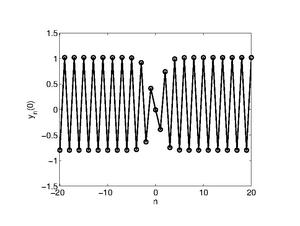
My most current work is in collaboration with Panos Kevrekidis to study localized structures in granular chains. An example of a granular crystal is shown on the left above (© Boechler/Theocharis Caltech 2011). A numerical solution of the relevant equations of motion is shown on the right. Such a solution is called a discrete dark breather, which is time periodic solution with a nonzero background. We work closely with several experimental groups, including
- Nicholas Boechler, Mechanical Engineering, Univ. Washington
- Chiara Daraio, Mechanics and Materials, ETH Zurich
- Georgios Theocharis, CNRS, Le Mans France
- Jinkyu Yang, Aeronautics & Astronautics, Univ. Washington
Justification of Amplitude Equations
 | 
|
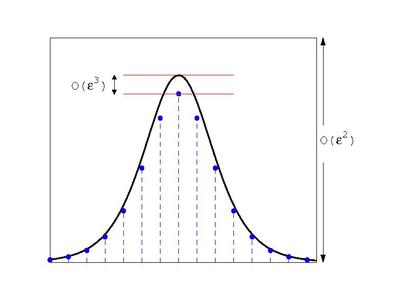
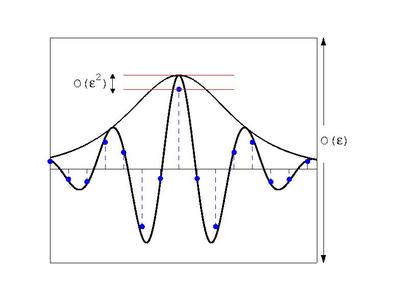
One focus of mine deals with the justification of amplitude equations. In the image above, solutions to a periodic Fermi-Pasta-Ulam lattice are shown (makers), with amplitudes approximately described by the Korteweg-de Vries equation (left) and the the nonlinear Schrödinger equation (right). Justification in this sense means that the error of such approximations is sufficiently small, see [10] for more details.
Another example is the justification of the NLS equation as an amplitude equation for semilinear wave equations with unstable quadratic resonances and for quasilinear systems with non-resonant quadratic terms. This research was conducted under the grant (Schn 520/8-1) which is sponsored by the German Research Foundation (DFG) and was headed by Guido Schneider.
Pulse Interaction
Shown above is a movie of two pulse evolution in the Klein-Gordon equation with a cubic nonlinearity
with rectangular (top) and NLS 1-soilton (bottom) envelopes.
See the paper [3] for more details.
The code to generate such solutions can be found in the
code section below.
Discrete Solitons
 |
|
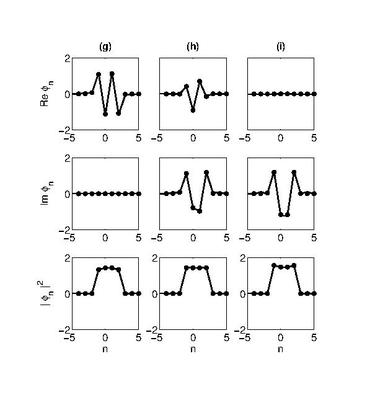
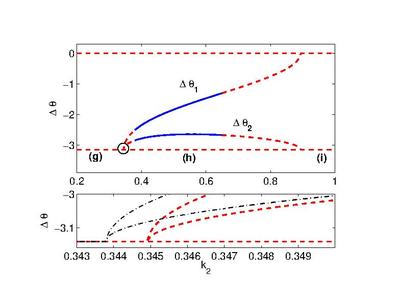
The discrete NLS equation (DNLS) with extended linear coupling is known to support discrete solitons (pictured left). Unlike in the standard DNLS equation, these solitons have complex valued amplitudes. Such solutions can be approximated using a variational approximation (VA), which reduces the infinite set of equations to a small (albeit complicated) system. Within this approximation, complex bifurcation scenarios can be captured. In the right panel above, the relative phase difference of adjacent nodes of the soliton solutions in the left panel are shown for exact solutions (colored lines) and the VA (black lines). See [7] for details. More recently, my collaborators and I have shown that the variational approximation can be justified rigorously [9]
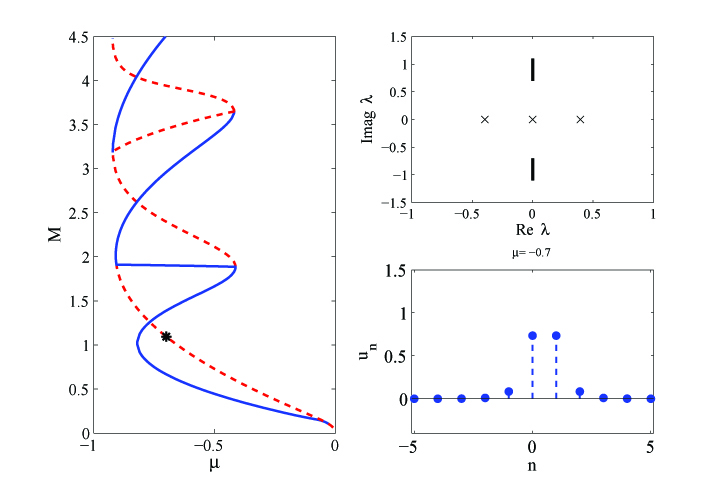
The image above shows the snaking structure of the discrete cubic-quintic NLS equation. The left panel shows the norm of various discrete solitons. An example of one solution is given in bottom right panel with the corresponding linear stability spectrum in the top right panel. See papers [1,4,6] for more details.
Codes
Numerical integrators for a cubic nonlinear Klein-Gordon equation written in MATLAB can be downloaded here.