IV.3 · Open & Closed Sets — Problem 3 #
← Back to IV. Open & Closed Sets, Problem 3
Problem. Let \(\overline{T}\) denote the closure of a set \(T\) in a metric space \((S,\rho)\). Show that \(\overline{T}\) is the smallest closed set containing \(T\): it is closed, it contains \(T\), and it is contained in every closed set that contains \(T\).
Hint #
“Smallest closed set containing \(T\)” really means two things: (i) \(\overline{T}\) is itself closed and contains \(T\), and (ii) if \(U\) is any closed set with \(T \subseteq U\), then \(\overline{T} \subseteq U\). For (ii), use \(\overline{T} = T \cup T'\) (the set together with its limit points) and the fact that a closed set contains all of its own limit points.
Solution #
Assume that \(U\) is a closed set which contains \(T\) and is itself contained in \(\overline{T}\), that is, \(T \subseteq U \subseteq \overline{T}\). Assume that there is a point \(p\) in \(\overline{T}\) which is not in \(U\). Because \(\overline{T} = T \cup T'\), the point \(p\) must lie in \(T\) or \(T'\). The first possibility cannot arise, since if \(p\) is in \(T\), then it must lie in \(U\) (because \(T \subseteq U\)).
If \(p\) lies in \(T'\), then it is a limit point of \(T\), and therefore a limit point of \(U\) (since \(T \subseteq U\)). But we are assuming that \(U\) is closed, and therefore it must contain all of its limit points. Therefore \(p\) must lie in \(U\), a contradiction. Therefore \(U\) must equal \(\overline{T}\), as desired.
Long solution #
Strategy. The phrase “smallest closed set containing \(T\)” packs three separate claims into five words, and the proof is simply to verify them one at a time: \(\overline{T}\) contains \(T\); \(\overline{T}\) is itself closed; and \(\overline{T}\) fits inside every closed set that contains \(T\). The first is immediate from the definition \(\overline{T} = T \cup T'\). The second requires showing that a limit point of \(\overline{T}\) is already a limit point of \(T\) itself — the one genuinely technical step, where we must nest a small ball inside a bigger one using the triangle inequality. The third is the picture below: a limit point of \(T\) is automatically a limit point of any superset \(U \supseteq T\), and a closed \(U\) must contain its limit points, so \(U\) has no choice but to contain all of \(\overline{T}\).
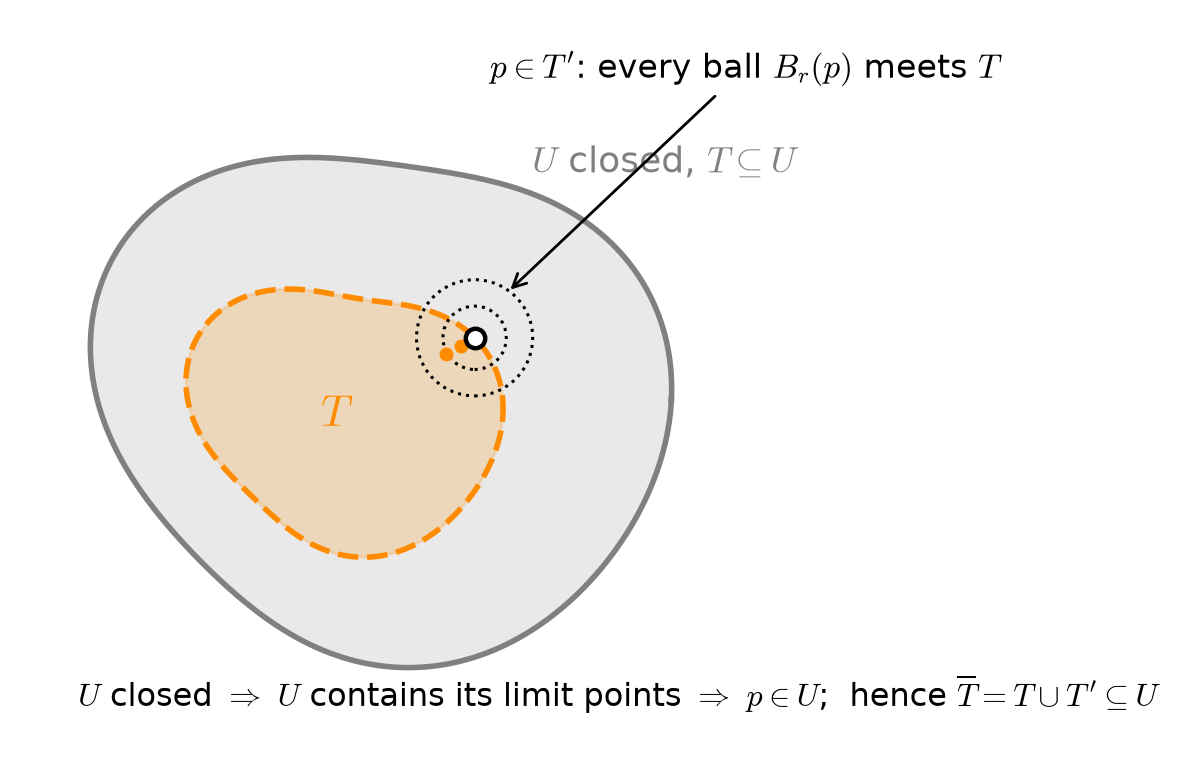
Minimality in a picture: \(T\) (orange, dashed boundary — its boundary points may be missing from \(T\)) sits inside a closed set \(U\) (gray). A limit point \(p\) of \(T\) has points of \(T\) in every ball around it, however small; those points also lie in \(U\), so \(p\) is a limit point of \(U\), and closedness forces \(p \in U\).
Definitions. A point \(p\) is a limit point of \(T\) if every ball \(B_r(p)\) (\(r > 0\)) contains at least one point of \(T\) other than \(p\). Write \(T'\) for the set of all limit points of \(T\). The closure is \(\overline{T} = T \cup T'\). A set is closed iff it contains all of its limit points (equivalently, iff its complement is open).
We verify three properties:
- \(T \subseteq \overline{T}\);
- \(\overline{T}\) is closed;
- if \(U\) is closed and \(T \subseteq U\), then \(\overline{T} \subseteq U\).
Property 3 is exactly the minimality statement: \(\overline{T}\) sits inside every closed set containing \(T\), so among all closed sets containing \(T\) it is the smallest. (Such a smallest set is automatically unique: if \(C\) were another closed set containing \(T\) and contained in every such set, then \(\overline{T} \subseteq C\) by minimality of \(C\) applied to \(\overline{T}\), and \(C \subseteq \overline{T}\) by property 3 applied to \(C\); hence \(C = \overline{T}\).)
1. \(T \subseteq \overline{T}\).
By definition \(\overline{T} = T \cup T'\), and a union contains each of the sets being unioned, so \(T \subseteq T \cup T' = \overline{T}\).
2. \(\overline{T}\) is closed.
By the characterization in the box, it suffices to show that \(\overline{T}\) contains all of its limit points: \((\overline{T})' \subseteq \overline{T}\). So let \(p\) be a limit point of \(\overline{T}\). Our plan is to show that \(p\) is in fact a limit point of the original set \(T\); then \(p \in T' \subseteq \overline{T}\) and we are done.
To show \(p \in T'\) we must check the definition: given an arbitrary radius \(r > 0\), we must find a point of \(T\), different from \(p\), inside \(B_r(p)\). Fix such an \(r\).
Since \(p\) is a limit point of \(\overline{T}\), the ball \(B_r(p)\) contains some point \(x \in \overline{T}\) with \(x \neq p\). We now want a small “buffer ball” around \(x\) that stays inside \(B_r(p)\) but excludes \(p\). Here is the scratch work for choosing its radius. We need two things:
- \(B_s(x) \subseteq B_r(p)\): if \(\rho(x,y) < s\), the triangle inequality gives \(\rho(p,y) \leq \rho(p,x) + \rho(x,y) < \rho(p,x) + s\), so it suffices to have \(\rho(p,x) + s \leq r\), i.e. \(s \leq r - \rho(p,x)\). (This quantity is positive because \(x \in B_r(p)\) means \(\rho(p,x) < r\).)
- \(p \notin B_s(x)\): we need \(\rho(x,p) \geq s\), i.e. \(s \leq \rho(p,x)\). (This quantity is positive because \(x \neq p\).)
Both demands are met by choosing
$$ s := \min\big\{\, r - \rho(p,x),\ \rho(p,x) \,\big\} > 0 . $$Now use \(x \in \overline{T} = T \cup T'\) and argue by cases:
- If \(x \in T\): then \(x\) itself is a point of \(T\) lying in \(B_r(p)\), and \(x \neq p\). Done.
- If \(x \in T'\): then \(x\) is a limit point of \(T\), so applying the definition of limit point with the radius \(s\), the ball \(B_s(x)\) contains a point \(t \in T\) with \(t \neq x\). By our first demand \(t \in B_s(x) \subseteq B_r(p)\), and by our second demand \(p \notin B_s(x)\) while \(t \in B_s(x)\), so \(t \neq p\). Thus \(t\) is a point of \(T\), different from \(p\), inside \(B_r(p)\). Done.
In both cases \(B_r(p)\) contains a point of \(T \setminus \{p\}\). Since \(r > 0\) was arbitrary, \(p\) is a limit point of \(T\), i.e. \(p \in T' \subseteq \overline{T}\). Hence \(\overline{T}\) contains all of its limit points and is closed.
3. Minimality: if \(U\) is closed and \(T \subseteq U\), then \(\overline{T} \subseteq U\).
Let \(p \in \overline{T} = T \cup T'\) be arbitrary; we show \(p \in U\) by cases.
- If \(p \in T\): then \(p \in U\) immediately, because \(T \subseteq U\).
- If \(p \in T'\): then \(p\) is a limit point of \(T\), so for every \(r > 0\) the ball \(B_r(p)\) contains a point \(t \in T\) with \(t \neq p\). Since \(T \subseteq U\), this same \(t\) belongs to \(U\). So every ball around \(p\) contains a point of \(U\) other than \(p\) — which is precisely the statement that \(p\) is a limit point of \(U\). (This is the general principle visible in the figure: enlarging a set can only create more limit points, never destroy them.) But \(U\) is closed, so it contains all of its limit points; hence \(p \in U\).
In either case \(p \in U\). Since \(p \in \overline{T}\) was arbitrary, \(\overline{T} \subseteq U\).
Combining 1–3: \(\overline{T}\) is a closed set containing \(T\), and it is contained in every closed set containing \(T\). That is, \(\overline{T}\) is the smallest closed set containing \(T\).
Remark. Property 3 gives a slick alternative description of the closure:
$$ \overline{T} = \bigcap \{\, U : U \text{ closed and } T \subseteq U \,\}, $$the intersection of all closed sets containing \(T\). Indeed, the intersection is closed by Problem 1(d), contains \(T\), and by property 3 contains no more than \(\overline{T}\) — while \(\overline{T}\) is itself one of the sets being intersected. Some textbooks take this intersection as the definition of closure; this problem shows the two definitions agree. \(\blacksquare\)