IV.2 · Open & Closed Sets — Problem 2 #
← Back to IV. Open & Closed Sets, Problem 2
Problem. Let \((S,\rho)\) be a metric space and \(p \in S\). Prove the singleton \(\{p\}\) is closed, and deduce that every finite set \(\{p_1,\dots,p_n\}\) is closed.
Hint #
Show the complement \(S \setminus \{p\}\) is open: given any \(q \neq p\), the distance \(r = \rho(p,q)\) is strictly positive, so the ball \(B_r(q)\) misses \(p\). For the finite set, write it as a finite union of singletons and quote Problem 1(c).
Solution #
If you recall from class that a singleton set in a metric space is always compact, and that compact sets are always closed, then the problem follows. Alternately, consider the complement of \(\{p\}\) in \(S\). For any point \(q\) of this complement, the ball \(B_r(q)\) of radius \(r = \rho(p,q)\) does not contain \(p\) and is therefore itself contained entirely in the complement of \(\{p\}\). But then by definition, the complement of \(\{p\}\) must be open, forcing \(\{p\}\) to be closed.
For the second statement, we can use the third part of the previous problem: \(\{p_1,\dots,p_n\} = \bigcup_{i=1}^n \{p_i\}\) is a finite union of closed sets, hence closed.
Long solution #
Strategy. To show \(\{p\}\) is closed we must show its complement \(S \setminus \{p\}\) is open, and openness is a pointwise job: we pick an arbitrary point \(q\) of the complement and must produce a radius \(r > 0\) whose ball \(B_r(q)\) avoids \(p\) entirely. What radius could work? The only obstruction is the single point \(p\), which sits at distance \(\rho(p,q)\) from \(q\). Any ball around \(q\) of radius at most that distance cannot reach \(p\) — so we simply take \(r = \rho(p,q)\), which is positive precisely because \(q \neq p\). The finite-set statement then costs nothing: a finite set is a finite union of singletons, and Problem 1(c) says finite unions of closed sets are closed.
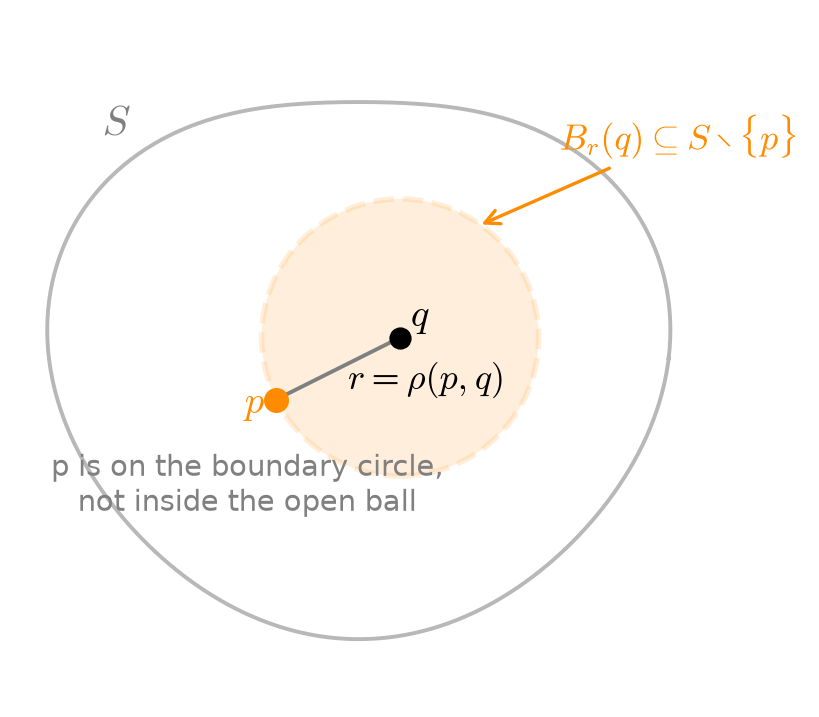
The choice of radius: taking \(r = \rho(p,q)\) puts \(p\) exactly on the boundary circle of \(B_r(q)\). Since the open ball consists of points at distance strictly less than \(r\) from \(q\), the point \(p\) is excluded, and the whole ball stays inside \(S \setminus \{p\}\).
Definitions. For \(q \in S\) and \(r > 0\), the open ball is \(B_r(q) = \{\, x \in S : \rho(q,x) < r \,\}\). A set \(U \subseteq S\) is open iff for every \(q \in U\) there is some \(r > 0\) with \(B_r(q) \subseteq U\). A set is closed iff its complement is open. We will also use two metric axioms: positivity (\(\rho(a,b) > 0\) whenever \(a \neq b\)) and symmetry (\(\rho(a,b) = \rho(b,a)\)).
Part 1: the singleton \(\{p\}\) is closed.
By definition, \(\{p\}\) is closed iff its complement
$$ U := S \setminus \{p\} = \{\, x \in S : x \neq p \,\} $$is open. So this is what we prove. Unwinding the definition of “open,” we must show: for every \(q \in U\) there exists \(r > 0\) such that \(B_r(q) \subseteq U\).
Let \(q \in U\) be arbitrary. Since \(q\) lies in the complement of \(\{p\}\), we know \(q \neq p\). By the positivity axiom of the metric, distinct points are at strictly positive distance, so the number
$$ r := \rho(p,q) $$satisfies \(r > 0\); it is therefore a legitimate radius. (This is the one place where \(q \neq p\) is used, and it is essential: if \(r\) were \(0\), the “ball” \(B_0(q)\) would be empty and useless.)
Claim: \(B_r(q) \subseteq U\), i.e. the ball contains no point equal to \(p\).
Proof of claim. Let \(x \in B_r(q)\) be arbitrary. By the definition of the open ball,
$$ \rho(q,x) < r = \rho(p,q). \tag{*} $$Suppose, for contradiction, that \(x = p\). Substituting \(x = p\) into the left side of \((*)\) and using symmetry of the metric,
$$ \rho(q,x) = \rho(q,p) = \rho(p,q) = r, $$so \((*)\) would read \(r < r\) — impossible. Hence \(x \neq p\), which means \(x \in S \setminus \{p\} = U\). Since \(x \in B_r(q)\) was arbitrary, \(B_r(q) \subseteq U\), proving the claim.
We have shown that every point \(q \in U\) admits a ball \(B_r(q) \subseteq U\) (with \(r\) depending on \(q\), which is allowed — openness only asks for some radius at each point). Therefore \(U\) is open, and its complement \(\{p\}\) is closed.
Part 2: every finite set is closed.
Let \(F = \{p_1, p_2, \dots, p_n\}\) be any finite subset of \(S\). A finite set is exactly the union of its one-point subsets:
$$ F = \{p_1\} \cup \{p_2\} \cup \cdots \cup \{p_n\} = \bigcup_{i=1}^{n} \{p_i\}. $$(Both sides have the same elements: \(x \in F\) iff \(x = p_i\) for some \(i\) iff \(x \in \{p_i\}\) for some \(i\).) By Part 1, each singleton \(\{p_i\}\) is closed. The index set \(\{1, 2, \dots, n\}\) is finite, so \(F\) is a finite union of closed sets, and Problem 1(c) tells us exactly that such a union is closed. Hence \(F\) is closed.
The degenerate case \(n = 0\) (the empty set) is also covered: \(\varnothing\) is closed by Problem 1(b).
Remark. Finiteness matters in Part 2 for the same reason as in Problem 1(c): an infinite set of points need not be closed. For instance, in \(\mathbb{R}\) the set \(\{1, \frac{1}{2}, \frac{1}{3}, \dots\} = \{1/n : n \in \mathbb{Z}^{+}\}\) is a union of closed singletons, but it is not closed, because \(0\) is a limit point of the set that does not belong to it. Note also that this proof never used the triangle inequality — positivity and symmetry alone suffice. \(\blacksquare\)