III.8 · Metric Spaces — Problem 8 #
← Back to III. Metric Spaces, Problem 8
Problem. For \(\vec{x} = (x_1, x_2)\) and \(\vec{y} = (y_1, y_2)\) in \(\mathbb{R}^2\), define \(\rho(\vec{x},\vec{y}) = |x_2 - y_2|\) if \(x_1 = y_1\), and \(\rho(\vec{x},\vec{y}) = |x_2| + |x_1 - y_1| + |y_2|\) if \(x_1 \neq y_1\). This is a metric. (a) Verify that \(\rho(\vec{x},\vec{y}) = 0\) iff \(\vec{x} = \vec{y}\). (b) Sketch \(B_1\big((0,0)\big)\), \(B_1\big((0,5)\big)\), and \(B_3\big((2,2)\big)\). (c) What real situation might this metric describe? (d) (Bonus) Invent a name for this metric.
Hint #
For (a), treat the two cases in the definition separately: in the second case the distance is at least \(|x_1 - y_1|\), which is positive. For (b), ask which points \(\vec{y}\) fall into each case, and remember that in the second case the distance is at least \(|x_2|\), the height of the center above the horizontal axis; the third ball has radius bigger than that height, so both cases contribute. For (c), read the second formula as the length of a three-leg journey.
Solution #
(a) If \(\vec{x} = \vec{y}\) then \(x_1 = y_1\), so the first case applies and \(\rho(\vec{x},\vec{y}) = |x_2 - x_2| = 0\). Conversely, suppose \(\rho(\vec{x},\vec{y}) = 0\). If \(x_1 \neq y_1\), the second case applies and \(\rho(\vec{x},\vec{y}) \geq |x_1 - y_1| > 0\), a contradiction; so \(x_1 = y_1\). Then the first case gives \(|x_2 - y_2| = 0\), so \(x_2 = y_2\) and \(\vec{x} = \vec{y}\).
(b) Write \(\vec{y} = (y_1, y_2)\).
The ball \(B_1\big((0,0)\big)\). If \(y_1 = 0\), the distance is \(|y_2|\), so the points \((0, y_2)\) with \(|y_2| < 1\) belong to the ball. If \(y_1 \neq 0\), the distance is \(0 + |y_1| + |y_2|\), so the ball contains all \(\vec{y}\) with \(|y_1| + |y_2| < 1\). Together: \(B_1\big((0,0)\big)\) is the open diamond with vertices \((\pm 1, 0)\) and \((0, \pm 1)\), exactly the unit ball of the metric \(\rho_1\).
The ball \(B_1\big((0,5)\big)\). If \(y_1 = 0\), the distance is \(|5 - y_2|\), so the points \((0, y_2)\) with \(4 < y_2 < 6\) belong to the ball. If \(y_1 \neq 0\), the distance is \(5 + |y_1| + |y_2| \geq 5\), so no such point is within distance \(1\). Thus \(B_1\big((0,5)\big)\) is just the open vertical segment from \((0,4)\) to \((0,6)\).
The ball \(B_3\big((2,2)\big)\). If \(y_1 = 2\), the distance is \(|2 - y_2|\), so the points \((2, y_2)\) with \(-1 < y_2 < 5\) belong to the ball. If \(y_1 \neq 2\), the distance is \(2 + |2 - y_1| + |y_2|\), which is less than \(3\) exactly when \(|y_1 - 2| + |y_2| < 1\): an open diamond of radius \(1\) centered at \((2,0)\), the foot of the center’s road. So \(B_3\big((2,2)\big)\) is the open segment from \((2,-1)\) to \((2,5)\) together with that diamond, a lollipop standing on the river.
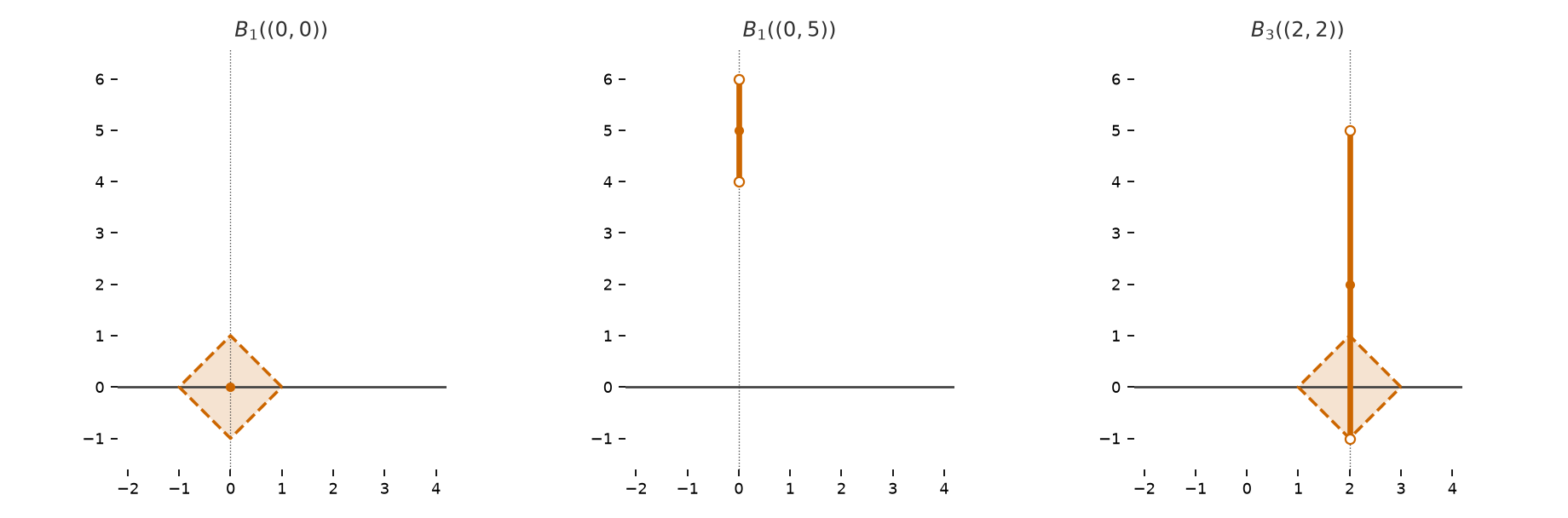
(c) Think of the horizontal axis as a river, or a highway, and the vertical lines as the only roads leading to it. To get from \(\vec{x}\) to \(\vec{y}\) you walk straight down your road to the river (distance \(|x_2|\)), travel along the river (distance \(|x_1 - y_1|\)), and walk up the other road (distance \(|y_2|\)). If both points lie on the same road, you never need the river and simply walk the vertical distance \(|x_2 - y_2|\). The ball \(B_1\big((0,5)\big)\) is a segment because a traveller starting five units up a road cannot reach any other road in fewer than five units.
(d) Any name that captures the picture is fine. In the literature this metric is usually called the river metric or the jungle river metric; its cousin in which all roads lead to a single point rather than a line is the French railway or all-roads-lead-to-Rome metric.