III.5 · Metric Spaces — Problem 5 #
← Back to III. Metric Spaces, Problem 5
Problem. Find a metric space \((S,\rho)\), points \(x,y \in S\), and radii \(r_1 > r_2 > 0\) such that \(B_{r_1}(x) \subseteq B_{r_2}(y)\) — a ball of larger radius contained in a ball of smaller radius.
Hint #
Look for a metric in which all sufficiently large balls are the same set. The discrete metric does exactly this.
Solution #
The discrete metric is useful for once! Let \((S, \rho)\) be a metric space with the discrete metric, that is,
$$\rho(a,b) = \begin{cases} 0 & a = b, \\ 1 & a \ne b. \end{cases}$$For any \(p \in S\), both \(B_2(p)\) and \(B_3(p)\) equal \(S\) (every point is within distance \(1 < 2\) of \(p\)). So with \(x = y = p\), \(r_1 = 3\) and \(r_2 = 2\), we have \(B_3(p) \subseteq B_2(p)\) and \(r_1 = 3 > 2 = r_2\), as desired.
Long solution #
In the discrete metric every distance is \(0\) or \(1\), so enlarging the radius past \(1\) adds nothing to a ball.
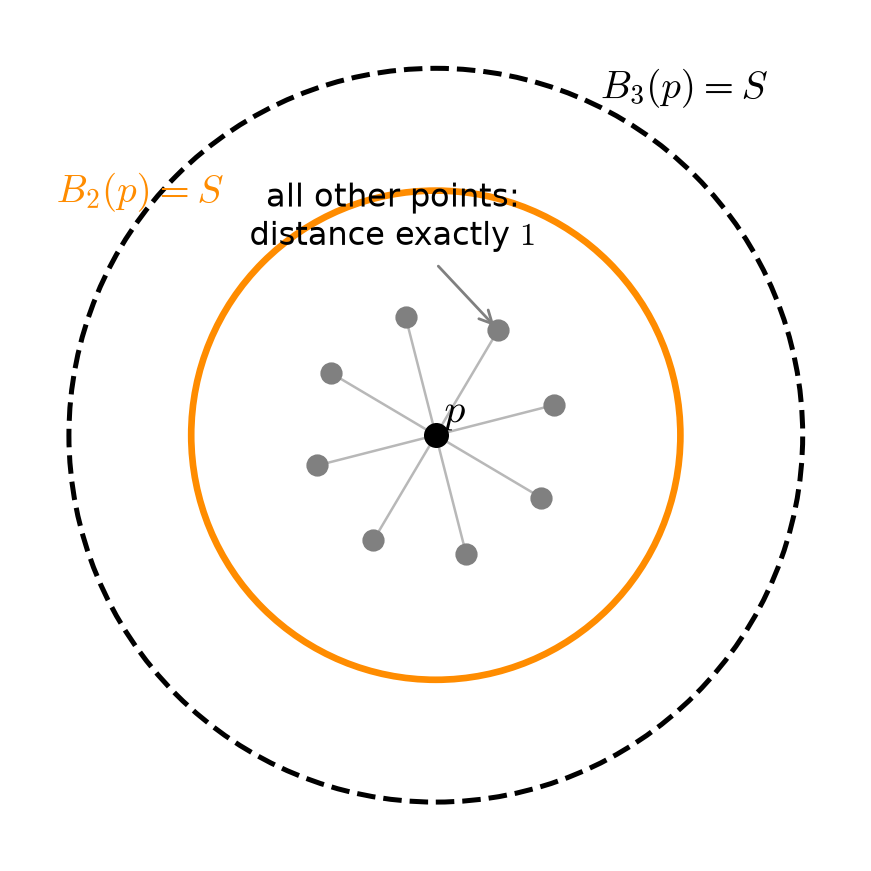
Every point of \(S\) is at distance \(\leq 1\) from \(p\), so \(B_2(p)\) (orange) and \(B_3(p)\) (dashed) are both all of \(S\).
Let \(S\) be any nonempty set with the discrete metric \(\rho\) above. Fix \(p \in S\) and \(r > 1\). For every \(s \in S\) we have \(\rho(s,p) \le 1 < r\), so \(s \in B_r(p)\); hence \(B_r(p) = S\) whenever \(r > 1\). Taking \(x = y = p\), \(r_1 = 3\), \(r_2 = 2\),
$$B_{r_1}(x) = S = B_{r_2}(y),$$so certainly \(B_{r_1}(x) \subseteq B_{r_2}(y)\) with \(r_1 > r_2\). \(\blacksquare\)