III.4 · Metric Spaces — Problem 4 #
← Back to III. Metric Spaces, Problem 4
Problem. Let \(M\subset\mathbb{R}^2\) be the open region of the state of Maine (islands included) and let \(a\in M\) be Augusta. Is there a metric \(\rho\) on \(\mathbb{R}^2\) with \(B_1(a)=M\)?
Hint #
There are at least two solutions. The cheap one uses a spiced-up version of the discrete metric: instead of a single nonzero distance, allow two of them, a smaller one for pairs of points on the same side of Maine’s border and a larger one for pairs on opposite sides. First convince yourself that any function with \(\rho(p,p)=0\) and all other values in the interval \([\tfrac12,1]\) satisfies the triangle inequality automatically.
For a less cheap solution, one whose open sets are the usual open sets of the plane, look for a continuous function \(h:\mathbb{R}^2\to[0,\infty)\) with \(h(a)=0\) and \(h<1\) exactly on \(M\), and combine \(|h(p)-h(q)|\) with a scaled-down Euclidean distance.
Solution #
Yes. Define \(\rho(p,p)=0\) for every \(p\), and for \(p\neq q\)
$$\rho(p,q)=\begin{cases}\tfrac12 & \text{if } p,q \text{ are both in } M \text{ or both not in } M,\\[2pt] 1 & \text{if exactly one of } p,q \text{ is in } M.\end{cases}$$Symmetry is clear, and \(\rho(p,q)=0\) only when \(p=q\). For the triangle inequality \(\rho(p,r)\le\rho(p,q)+\rho(q,r)\): if \(p=q\) or \(q=r\) it is an equality, and otherwise the right side is at least \(\tfrac12+\tfrac12=1\), which is the largest value \(\rho\) ever takes. So \(\rho\) is a metric. Since \(a\in M\), a point \(p\) has \(\rho(p,a)<1\) exactly when \(p=a\) or \(p\) is on the same side of the border as \(a\), that is, exactly when \(p\in M\). Hence \(B_1(a)=M\).
The same argument shows that in this metric every subset of the plane containing \(a\) is the unit ball about \(a\), which is why this solution is cheap. The long solution also gives a metric that still knows about the geometry of the plane.
Long solution #
Strategy. The question is really about how much freedom the metric axioms leave. The cheap answer shows they leave a great deal: with only the values \(0\), \(\tfrac12\), \(1\) available, the triangle inequality can never fail, so any two-class partition of the plane produces a metric, and the class containing \(a\) is the unit ball. The second answer shows the freedom persists even if we insist that the metric describe the same “nearness” as the Euclidean one. The idea there is to measure distance in two ways at once, by Euclidean distance and by the difference in an altitude \(h\) that is \(0\) at Augusta, rises to \(1\) along the border, and keeps rising outside, and to take the larger of the two.
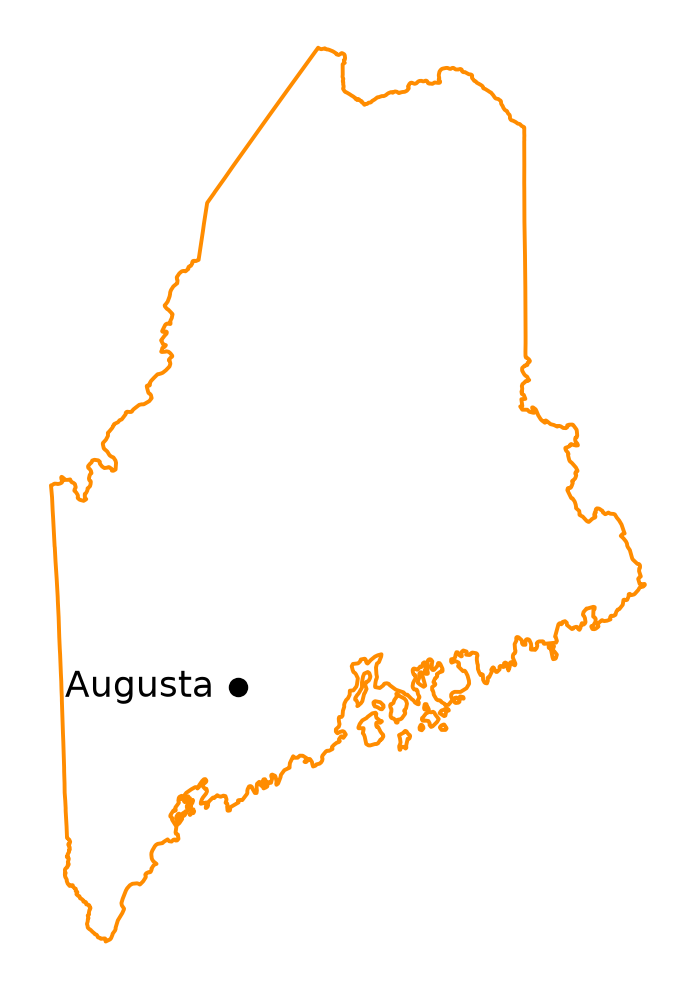
The region \(M\) is open and bounded, and its boundary \(\partial M\) is the orange curve. Both metrics below make \(M\) the open unit ball about Augusta; the second also makes \(\partial M\) the unit sphere.
Part 1: the spiced-up discrete metric. Recall the discrete metric takes the value \(1\) on every pair of distinct points. Its triangle inequality holds for a very simple reason: the right side \(\rho(p,q)+\rho(q,r)\) is at least \(1\) as soon as \(q\) differs from both \(p\) and \(r\), and \(1\) is the largest value on the left. The same reasoning covers any metric whose nonzero values lie in an interval \([m,2m]\).
Lemma. Let \(S\) be a set and \(\rho:S\times S\to[0,\infty)\) a symmetric function with \(\rho(p,q)=0\) if and only if \(p=q\). If every nonzero value of \(\rho\) lies in \([m,2m]\) for some \(m>0\), then \(\rho\) is a metric.
Proof. Only the triangle inequality \(\rho(p,r)\le\rho(p,q)+\rho(q,r)\) needs checking. If \(q=p\) or \(q=r\), the two sides are equal. Otherwise both terms on the right are at least \(m\), so the right side is at least \(2m\), while the left side is at most \(2m\). \(\square\)
Now define \(\rho\) as in the short solution: \(\rho(p,q)=\tfrac12\) for distinct points on the same side of the border and \(\rho(p,q)=1\) for points on opposite sides. The nonzero values lie in \([\tfrac12,1]\), so the Lemma applies and \(\rho\) is a metric. For any \(p\),
$$\rho(p,a)=\begin{cases}0 & p=a,\\ \tfrac12 & p\in M,\ p\neq a,\\ 1 & p\notin M,\end{cases}$$so \(\rho(p,a)<1\) if and only if \(p\in M\). That is, \(B_1(a)=M\). \(\blacksquare\)
Note that nothing about Maine was used: the Lemma turns any partition of any set into two classes into a metric in which each class is an open ball of radius \(1\) about any of its points. Note also that the unit sphere \(S_1(a)=\{p:\rho(p,a)=1\}\) is everything outside Maine, not the border.
Part 2: a metric with the usual open sets. We now construct a metric \(d\) on \(\mathbb{R}^2\) with \(B_1(a)=M\) and with constants \(0<\epsilon\le L\) such that
$$\epsilon\,|p-q|\ \le\ d(p,q)\ \le\ L\,|p-q|\qquad\text{for all }p,q, \tag{1}$$where \(|p-q|\) is Euclidean distance. Inequality (1) forces \(d\) and the Euclidean metric to have the same open sets: every \(d\)-ball contains a Euclidean ball about the same center, and vice versa.
The altitude function. Since \(M\) is open and \(a\in M\), the Euclidean distance \(c\) from \(a\) to the complement \(\mathbb{R}^2\setminus M\) is positive. Define
$$h(p)=\begin{cases}1-\min\!\Big(1,\ \dfrac{\operatorname{dist}(p,\mathbb{R}^2\setminus M)}{c}\Big) & p\in M,\\[10pt] 1+\operatorname{dist}(p,M) & p\notin M,\end{cases}$$where \(\operatorname{dist}(p,A)=\inf_{x\in A}|p-x|\). Three properties matter:
- \(h(a)=0\), since \(\operatorname{dist}(a,\mathbb{R}^2\setminus M)=c\).
- \(h<1\) exactly on \(M\): for \(p\in M\) the distance to the complement is positive because \(M\) is open, so \(h(p)<1\); for \(p\notin M\), \(h(p)\ge 1\). Moreover \(h=1\) exactly on the boundary \(\partial M\) (points outside \(M\) at distance \(0\) from \(M\)).
- \(h\) is Lipschitz with constant \(K=\max(1,1/c)\). The function \(p\mapsto\operatorname{dist}(p,A)\) is \(1\)-Lipschitz for any set \(A\), so \(h\) is \((1/c)\)-Lipschitz on \(M\) and \(1\)-Lipschitz off \(M\). If \(p\in M\) and \(q\notin M\), the segment from \(p\) to \(q\) crosses \(\partial M\) at some point \(b\) with \(h(b)=1\), and \(|h(p)-h(q)|\le|h(p)-h(b)|+|h(b)-h(q)|\le K|p-b|+K|b-q|=K|p-q|\).
The metric. Because \(M\) is bounded, we can choose \(\epsilon>0\) so small that the closure \(\overline M\) lies inside the Euclidean disk of radius \(1/\epsilon\) about \(a\). Set
$$d(p,q)=\max\big(\,|h(p)-h(q)|,\ \epsilon\,|p-q|\,\big).$$This is a metric: it is symmetric; it vanishes only when \(\epsilon|p-q|=0\), i.e. \(p=q\); and the triangle inequality holds for each of the two expressions inside the max separately, hence for their maximum. Inequality (1) holds with \(L=\max(K,\epsilon)\), by the Lipschitz bound on \(h\).
The unit ball. Since \(h(a)=0\),
$$d(p,a)=\max\big(h(p),\ \epsilon|p-a|\big)<1 \iff h(p)<1 \ \text{ and }\ |p-a|<1/\epsilon.$$The first condition says \(p\in M\), and by the choice of \(\epsilon\) every point of \(M\) satisfies the second. Hence \(B_1(a)=M\). \(\blacksquare\)
Better still, the unit sphere is now the border: \(d(p,a)=1\) forces \(h(p)=1\) with \(|p-a|\le 1/\epsilon\), or \(|p-a|=1/\epsilon\) with \(h(p)\le 1\), and the second case is empty since \(\overline M\) lies strictly inside that disk. So \(S_1(a)=\{h=1\}=\partial M\), exactly the orange curve in the figure.
Remark. For a metric with the usual open sets, an open ball must be an open set, so Maine with its border cannot be an open ball; it can, however, be the closed ball \(\{d\le 1\}\) of the metric above. The islands are no obstruction in either construction: open balls need not be connected, just as Problem 5 shows they need not be nested by radius. The construction in Part 2 works for any bounded open set \(U\) in any metric space and any point \(a\in U\), which says that “being an open ball” carries no geometric information at all once the metric is allowed to change.