III.3 · Metric Spaces — Problem 3 #
← Back to III. Metric Spaces, Problem 3
Problem. For the \(p\)-metric \(\rho_p(\vec v, \vec w) = \sqrt[p]{\,|v_1-w_1|^p + \cdots + |v_n-w_n|^p\,}\), draw the unit sphere \(S_1(\vec 0)\) in the metric spaces \((\mathbb{R}^2,\rho_2)\), \((\mathbb{R}^2,\rho_1)\), \((\mathbb{R}^2,\rho_\infty)\), \((\mathbb{R}^3,\rho_1)\), and \((\mathbb{R}^2,\rho_3)\).
Hint #
The unit sphere is \(S_1(\vec 0) = \{\vec x : \rho_p(\vec x, \vec 0) = 1\}\). In \(\mathbb{R}^2\) write out the defining equation \(|x|^p + |y|^p = 1\) and ask what curve it traces. For \(\rho_\infty\), recall \(\rho_\infty(\vec x, \vec 0) = \max_i |x_i|\). Larger \(p\) interpolates between the \(\rho_1\) diamond and the \(\rho_\infty\) square.
Solution #
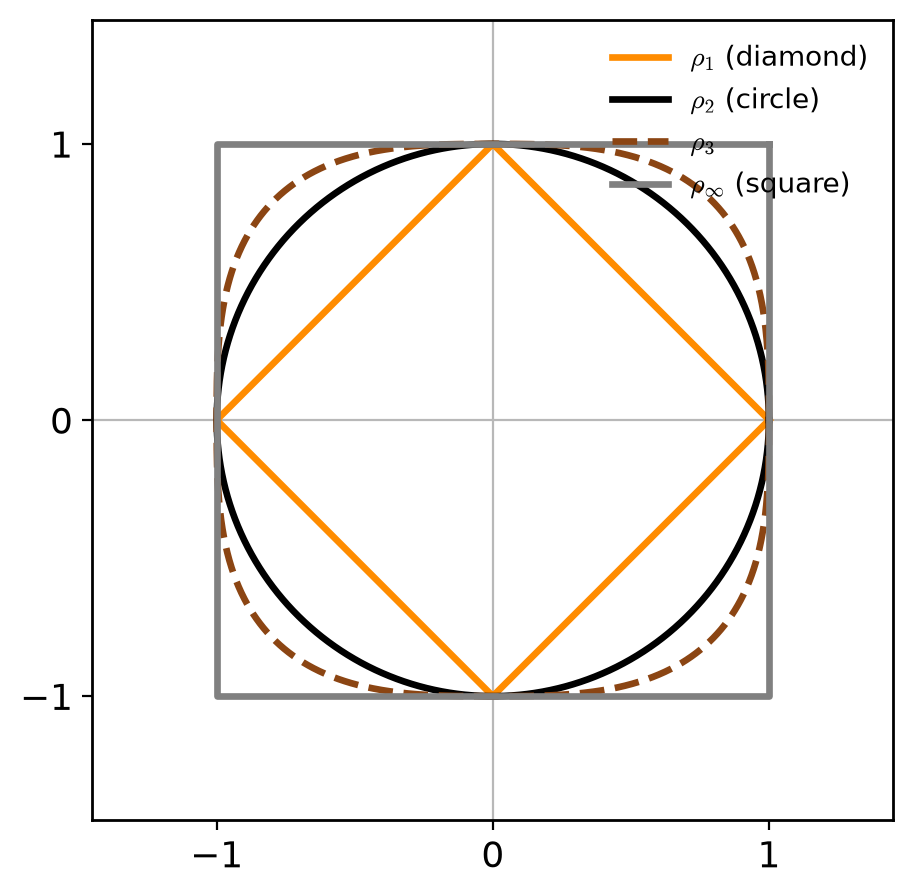
Unit circles \(S_1(\vec 0)\) in \((\mathbb{R}^2,\rho_p)\): the \(\rho_1\) diamond, the \(\rho_2\) circle, the \(\rho_3\) "squircle," and the \(\rho_\infty\) square. As \(p\) increases the ball grows from the diamond out toward the square.
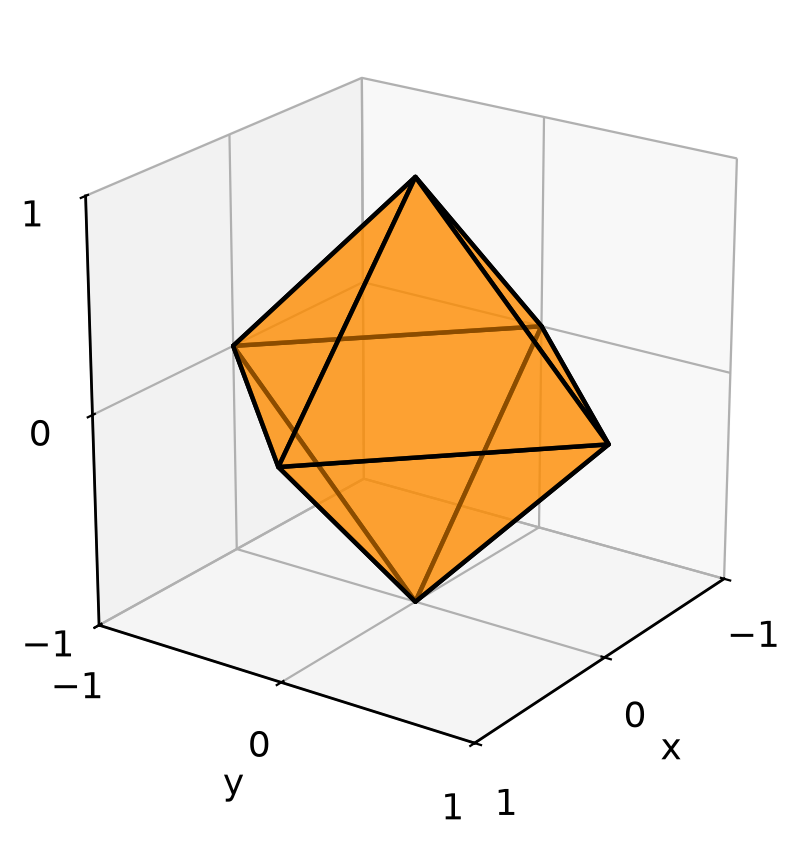
The unit ball of \((\mathbb{R}^3,\rho_1)\) is the octahedron with vertices \(\pm e_1,\pm e_2,\pm e_3\).
In \((\mathbb{R}^2, \rho_2)\), \(S_1(\vec 0)\) is a circle of radius one around the origin.
In \((\mathbb{R}^2, \rho_1)\), it is the square (a diamond) with vertices \((\pm 1, 0)\) and \((0, \pm 1)\).
In \((\mathbb{R}^2, \rho_\infty)\), it is the square with vertices \((\pm 1, \pm 1)\).
In \((\mathbb{R}^3, \rho_1)\), \(S_1(\vec 0)\) is the polyhedron (an octahedron) with vertices \((0,0,\pm 1)\), \((0,\pm 1, 0)\), and \((\pm 1, 0, 0)\).
The last one, \((\mathbb{R}^2, \rho_3)\), is more interesting to draw. It is a curve that lies between the unit sphere for \(\rho_2\) and the one for \(\rho_\infty\) in \(\mathbb{R}^2\) — a rounded square bulging slightly outside the circle toward the corners.
Long solution #
Strategy. “Draw the unit sphere” is really an equation-solving problem in disguise: the unit sphere is the set of points whose distance from the origin equals \(1\), so the first step is to unwrap \(\rho_p(\vec x, \vec 0) = 1\) into a concrete equation in the coordinates. The \(p\)-th root is a nuisance, but it can be removed cleanly because \(t \mapsto t^p\) is strictly increasing. That leaves the equation \(\sum_i |x_i|^p = 1\), which we analyze case by case. Two tools do most of the drawing: (i) the absolute values make the equation symmetric under sign flips of each coordinate, so it suffices to solve it in the first quadrant (or octant) and reflect; (ii) for the unfamiliar \(p = 3\) case, comparing the sizes of \(\rho_2\), \(\rho_3\), \(\rho_\infty\) for a fixed point tells us how the three curves nest inside one another. The two figures in the short solution above show the final answers; here we justify every feature of them.
Definitions. In a metric space \((S,\rho)\), the sphere of radius \(r > 0\) about \(z\) is \(S_r(z) = \{x \in S : \rho(x,z) = r\}\) — the points at distance exactly \(r\) (the ball \(B_r(z)\) uses \(< r\) instead). The metric \(\rho_\infty\) is defined by \(\rho_\infty(\vec x, \vec w) = \max_i |x_i - w_i|\); the notation is justified because \(\rho_p(\vec x, \vec w) \to \rho_\infty(\vec x, \vec w)\) as \(p \to \infty\).
Step 1: remove the root. By definition,
$$S_1(\vec 0) = \{\,\vec x : \rho_p(\vec x, \vec 0) = 1\,\}, \qquad \rho_p(\vec x, \vec 0) = \Bigl(\sum_{i=1}^n |x_i|^p\Bigr)^{1/p}.$$The function \(t \mapsto t^p\) is strictly increasing on \([0,\infty)\) (for \(0 \leq s < t\), multiplying \(s < t\) by itself \(p\) times preserves the strict inequality), so it is injective there: two non-negative numbers with equal \(p\)-th powers are equal. Hence, for a non-negative quantity, “\((\cdot)^{1/p} = 1\)” holds exactly when “\((\cdot) = 1^p = 1\)”. The condition \(\rho_p(\vec x,\vec 0) = 1\) is therefore equivalent to the polynomial equation
$$\sum_{i=1}^n |x_i|^p = 1. \tag{*}$$Now we solve \((\ast)\) in each requested space.
\((\mathbb{R}^2, \rho_2)\): the Euclidean circle. Here \((\ast)\) reads \(|x|^2 + |y|^2 = 1\), and since \(|x|^2 = x^2\), this is \(x^2 + y^2 = 1\): precisely the unit circle centered at the origin, i.e. the boundary of the ordinary disk of radius \(1\). This is the familiar case that anchors intuition for the others.
\((\mathbb{R}^2, \rho_1)\): a diamond. Now \((\ast)\) reads \(|x| + |y| = 1\). Because the equation involves only \(|x|\) and \(|y|\), replacing \(x\) by \(-x\) or \(y\) by \(-y\) does not change it: the solution set is symmetric under reflection in both axes. So it suffices to solve in the closed first quadrant \(x, y \geq 0\), where the equation becomes linear: \(x + y = 1\), with \(0 \leq x \leq 1\). That is the straight segment from \((1,0)\) to \((0,1)\). Reflecting this segment into the other three quadrants produces the four sides of a square rotated \(45^\circ\) — a diamond — with vertices \((\pm 1, 0)\) and \((0, \pm 1)\). (See the first figure above, innermost curve.)
\((\mathbb{R}^2, \rho_\infty)\): an axis-aligned square. Here we use the definition directly rather than \((\ast)\): the condition is \(\max\{|x|, |y|\} = 1\). Saying the larger of \(|x|, |y|\) equals \(1\) says two things at once: neither exceeds \(1\), and at least one equals \(1\). The points satisfying this are exactly the boundary of the square \([-1,1] \times [-1,1]\): the two vertical sides \(x = \pm 1\) with \(|y| \leq 1\), and the two horizontal sides \(y = \pm 1\) with \(|x| \leq 1\). The vertices are \((\pm 1, \pm 1)\) — note these are at Euclidean distance \(\sqrt2\) from the origin, yet at \(\rho_\infty\)-distance \(1\).
\((\mathbb{R}^3, \rho_1)\): an octahedron. Equation \((\ast)\) reads \(|x| + |y| + |z| = 1\), symmetric under flipping the sign of any coordinate, so we solve in the closed first octant \(x, y, z \geq 0\): there it is the plane equation \(x + y + z = 1\), intersected with the octant. That intersection is the flat triangle with vertices \((1,0,0)\), \((0,1,0)\), \((0,0,1)\) (set two coordinates to \(0\) to find each vertex). Reflecting through all \(2^3 = 8\) sign choices yields eight such triangular faces, which meet along edges and share the six vertices
$$(\pm 1, 0, 0),\quad (0, \pm 1, 0),\quad (0, 0, \pm 1).$$The resulting surface is the regular octahedron shown in the second figure above.
\((\mathbb{R}^2, \rho_3)\): a rounded square between the circle and the \(\rho_\infty\) square. Equation \((\ast)\) reads \(|x|^3 + |y|^3 = 1\). This is no conic section, so instead of naming the curve we locate it relative to the curves we already know. The key comparison fact:
for a fixed vector \(\vec x \neq \vec 0\), the value \(\rho_p(\vec x, \vec 0)\) is non-increasing in \(p\).
Proof of the comparison. Let \(p \leq q\) and write \(M = \rho_p(\vec x, \vec 0) > 0\). Set \(u_i = |x_i| / M\); then by construction \(\sum_i u_i^p = 1\). In particular each \(u_i^p \leq 1\), so each \(u_i \leq 1\) (again because \(t \mapsto t^p\) is increasing). For a number \(u \in [0,1]\), higher powers are smaller: \(u^q \leq u^p\) (multiplying by extra factors \(u \leq 1\) cannot increase the product). Summing, \(\sum_i u_i^q \leq \sum_i u_i^p = 1\), and taking \(q\)-th roots (increasing, so order-preserving) gives \(\bigl(\sum_i u_i^q\bigr)^{1/q} \leq 1\). Multiplying back by \(M\),
$$\rho_q(\vec x, \vec 0) = M \Bigl(\sum_i u_i^q\Bigr)^{1/q} \leq M = \rho_p(\vec x, \vec 0). \qquad\square$$Now apply this with \(2 \leq 3\): at any fixed point, the \(\rho_3\)-distance to the origin is \(\leq\) the \(\rho_2\)-distance. So walking outward from the origin along a ray, one reaches \(\rho_2\)-distance \(1\) before reaching \(\rho_3\)-distance \(1\); the \(\rho_3\) unit sphere therefore lies outside (or on) the Euclidean circle. Likewise \(\rho_\infty \leq \rho_3\) (the max of the \(|x_i|\) is at most the \(\rho_3\) value: \(\max_i |x_i|^3 \leq \sum_i |x_i|^3\), then take cube roots), so by the same ray argument the \(\rho_3\) sphere lies inside (or on) the \(\rho_\infty\) square.
Concrete checkpoints confirm this. On the axes, one coordinate is \(0\) and \((\ast)\) forces the other to be \(\pm 1\): all the curves pass through \((\pm 1, 0)\) and \((0, \pm 1)\). On the diagonal \(y = x > 0\), \((\ast)\) becomes \(2x^3 = 1\), so \(x = 2^{-1/3} \approx 0.794\): the \(\rho_3\) curve reaches \((0.794, 0.794)\), farther out than the circle’s diagonal point \(\bigl(2^{-1/2}, 2^{-1/2}\bigr) \approx (0.707, 0.707)\) but well inside the square’s corner \((1,1)\). The picture (first figure above, between the circle and the square) is a rounded square — a “squircle” — bulging past the unit circle toward the corners without reaching them. As \(p\) increases from \(1\) to \(\infty\), the unit sphere sweeps continuously from the diamond through the circle (\(p = 2\)) and the rounded square (\(p = 3\)) out toward the full square. \(\blacksquare\)
Remark. All these “spheres” contain the same four axis points, yet their shapes differ wildly — a first hint that a metric’s balls, not the ambient set, carry its geometry. It is also worth remembering that \(\rho_p\) satisfies the triangle inequality only for \(p \geq 1\); for \(0 < p < 1\) the “unit sphere” \(|x|^p + |y|^p = 1\) caves inward (a star shape) and \(\rho_p\) fails to be a metric.