III.2 · Metric Spaces — Problem 2 #
← Back to III. Metric Spaces, Problem 2
Problem. On \(\mathbb{R}^n\) define \(\rho_1(\vec{v},\vec{w}) = \sum_{i=1}^n |v_i - w_i|\) (the “taxicab metric” when \(n=2\)). Prove that \((\mathbb{R}^2, \rho_1)\) is a metric space.
Hint #
Check the four metric axioms in turn: non-negativity, the identity of indiscernibles (\(\rho_1(\vec v,\vec w)=0 \iff \vec v=\vec w\)), symmetry, and the triangle inequality. Each one reduces to the corresponding fact about absolute value of real numbers, applied coordinate-by-coordinate and then summed.
Solution #
We have to make sure that all axioms for a metric space are satisfied.
- In the first place, it is easy to see that \(\rho_1\) is always non-negative, since it is a sum of absolute values.
- If \(\vec{v} = \vec{w}\), then \(|v_i - w_i| = 0\) for all \(i\) and consequently \(\rho_1(\vec{v},\vec{w}) = 0\). Conversely, if \(\rho_1(\vec{v},\vec{w}) = 0\), and \(\rho_1(\vec{v},\vec{w})\) is a sum of non-negative numbers, then every \(|v_i - w_i| = 0\). But then \(v_i = w_i\) for all \(i\), or in other words, \(\vec{v} = \vec{w}\).
- Note that \(|v_i - w_i| = |w_i - v_i|\) for all \(i\), so that \(\rho_1(\vec{v},\vec{w}) = \rho_1(\vec{w},\vec{v})\), and the metric is symmetric.
- Note that for all \(i\), we have \(|v_i - z_i| \le |v_i - w_i| + |w_i - z_i|\) by the usual triangle inequality for real numbers. Adding these up for all \(i\), we obtain $$\sum_{i=1}^n |v_i - z_i| \le \sum_{i=1}^n |v_i - w_i| + \sum_{i=1}^n |w_i - z_i|,$$ or, by definition, \(\rho_1(\vec{v},\vec{z}) \le \rho_1(\vec{v},\vec{w}) + \rho_1(\vec{w},\vec{z})\).
Long solution #
Strategy. The proof is a checklist: verify each of the four metric axioms. Since \(\rho_1\) is built from absolute values coordinate by coordinate, every axiom reduces to the corresponding property of \(|\cdot|\) on \(\mathbb{R}\), applied in each coordinate and then summed.
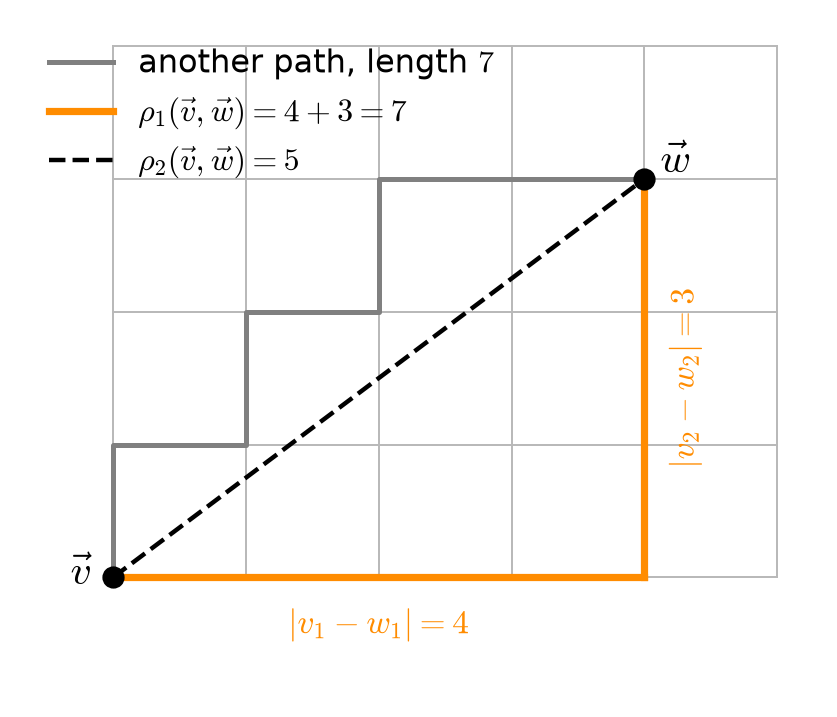
Why “taxicab”: every monotone staircase path from \(\vec v\) to \(\vec w\) in a street grid has length \(|v_1-w_1| + |v_2-w_2| = 4 + 3 = 7\), whereas the straight-line distance is \(5\).
Definition (metric space). A function \(\rho : S \times S \to \mathbb{R}\) is a metric on a set \(S\) if for all \(x,y,z \in S\):
(M1) \(\rho(x,y) \geq 0\) (non-negativity); (M2) \(\rho(x,y) = 0\) if and only if \(x = y\) (identity of indiscernibles); (M3) \(\rho(x,y) = \rho(y,x)\) (symmetry); (M4) \(\rho(x,z) \leq \rho(x,y) + \rho(y,z)\) (triangle inequality).
We argue for general \(n\), since the argument is identical; the case \(n=2\) is the taxicab metric \(\rho_1(\vec v,\vec w) = |v_1 - w_1| + |v_2 - w_2|\) pictured above.
Properties of the absolute value. For all \(a, b \in \mathbb{R}\):
- \(|a| \geq 0\), with \(|a| = 0\) if and only if \(a = 0\);
- \(|-a| = |a|\);
- \(|a + b| \leq |a| + |b|\) (triangle inequality on \(\mathbb{R}\)).
Now the checklist.
(M1) Non-negativity. Each term satisfies \(|v_i - w_i| \geq 0\) by property 1, and a finite sum of non-negative reals is non-negative. Hence \(\rho_1(\vec v, \vec w) \geq 0\).
(M2) Identity of indiscernibles. (\(\Leftarrow\)) If \(\vec v = \vec w\), then \(v_i = w_i\) for every \(i\), so every term \(|v_i - w_i|\) is \(0\) and \(\rho_1(\vec v, \vec w) = 0\).
(\(\Rightarrow\)) Suppose \(\sum_{i=1}^n |v_i - w_i| = 0\). If some term were strictly positive, the sum of non-negative terms would be positive too. So every \(|v_i - w_i| = 0\), which by property 1 gives \(v_i = w_i\) for all \(i\), i.e. \(\vec v = \vec w\).
(M3) Symmetry. For each \(i\), property 2 gives \(|v_i - w_i| = |-(w_i - v_i)| = |w_i - v_i|\). Summing over \(i\),
$$\rho_1(\vec v, \vec w) = \sum_{i=1}^n |v_i - w_i| = \sum_{i=1}^n |w_i - v_i| = \rho_1(\vec w, \vec v).$$(M4) Triangle inequality. For each \(i\), add and subtract \(w_i\), then apply property 3:
$$|v_i - z_i| = |(v_i - w_i) + (w_i - z_i)| \leq |v_i - w_i| + |w_i - z_i|.$$Summing these \(n\) inequalities and splitting the right-hand sum,
$$\sum_{i=1}^n |v_i - z_i| \leq \sum_{i=1}^n |v_i - w_i| + \sum_{i=1}^n |w_i - z_i|,$$which by definition of \(\rho_1\) says \(\rho_1(\vec v, \vec z) \leq \rho_1(\vec v, \vec w) + \rho_1(\vec w, \vec z)\).
All four axioms hold, so \((\mathbb{R}^2, \rho_1)\), and indeed \((\mathbb{R}^n, \rho_1)\) for every \(n\), is a metric space. \(\blacksquare\)