II.7 · Fields & Order — Problem 7 #
← Back to II. Fields & Order, Problem 7
Problem. Does there exist a finite ordered field?
Hint #
In a finite totally ordered set there is a largest element. What happens if you add the largest positive element to itself? Closure under addition should cause trouble.
Solution #
No. Suppose \(F\) were a finite ordered field. Then \(F\) must have a greatest element \(a\) (a nonempty finite totally ordered set has a maximum — why?). Consider the element \(a+a\). Since \(a>0\) (the maximum of a field containing \(1>0\) is positive), the first axiom of an ordered field implies \(a+a>a+0\); in particular, \(a+a>a\). But \(a+a\) is another element of \(F\) by field axiom A1, and it is bigger than \(a\). This contradicts the maximality of \(a\), so such an \(F\) cannot exist.
Long solution #
Strategy. The answer is no. Finiteness supplies a ceiling: a finite totally ordered set has a greatest element \(a\). The ordered field axioms supply an escalator: from any positive element \(a\), compatibility with addition produces the strictly larger element \(a+a\), which closure keeps inside \(F\). A set cannot have both.
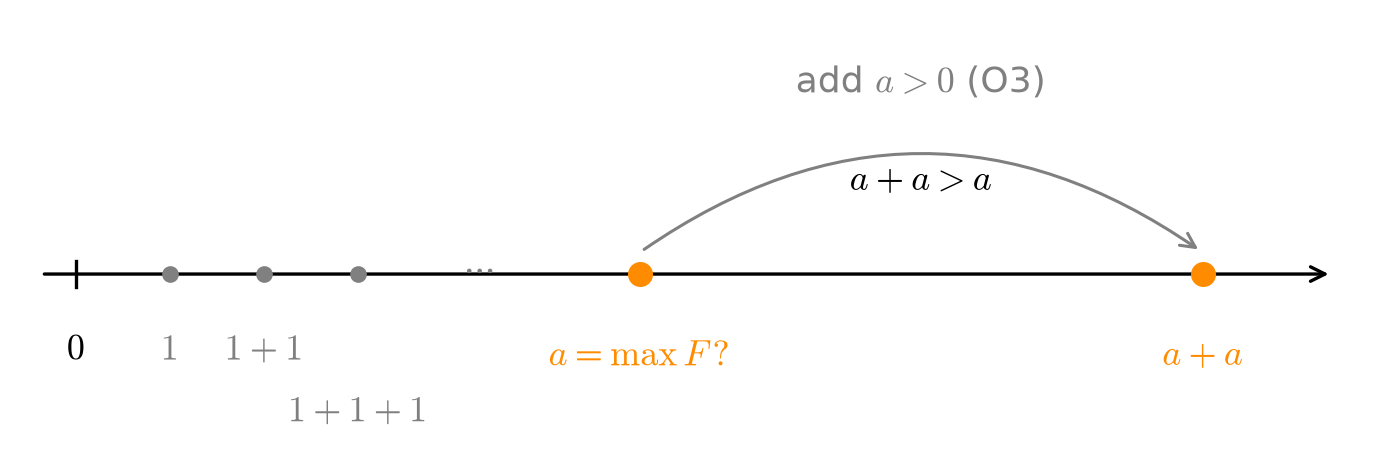
If \(a\) were the largest element of \(F\), adding \(a\) to both sides of \(0\lt a\) (axiom O3) would produce \(a+a\in F\) strictly beyond it. The gray chain \(1,\ 1+1,\ 1+1+1,\dots\) shows the same escalator starting from \(1\).
Lemma (finite total orders have maxima). Every nonempty finite totally ordered set \((X,<)\) has a maximum: an element \(a\in X\) with \(x\le a\) for all \(x\in X\).
Proof, by induction on \(|X|\). A one-element set is its own maximum. If \(|X|=n+1\), pick \(x_0\in X\) and let \(m\) be the maximum of \(X\setminus\{x_0\}\), which exists by the inductive hypothesis. By trichotomy either \(x_0\lt m\), in which case \(m\) is the maximum of \(X\), or \(m\lt x_0\), in which case \(x_0\) exceeds \(m\) and, by transitivity, every other element as well. \(\square\)
Suppose, toward a contradiction, that \((F,+,\cdot,<)\) is an ordered field with \(F\) finite.
Step 1: \(F\) has a greatest element \(a\). \(F\) is nonempty (it contains \(0\) and \(1\)), finite, and totally ordered by trichotomy (O1), so the Lemma gives \(a\in F\) with \(x\le a\) for all \(x\in F\).
Step 2: \(a>0\). By Problem 3(b), \(1>0\), and \(1\le a\) by maximality. So \(0<1\le a\), and transitivity (O2), or equality if \(a=1\), gives \(0\lt a\).
Step 3: a larger element. Apply O3 to \(0\lt a\), adding \(a\) to both sides: \(0+a\lt a+a\), that is, \(a\lt a+a\).
Step 4: the contradiction. By closure (A1), \(a+a\in F\), so \(a+a\le a\) by maximality. But Step 3 says \(a\lt a+a\), and trichotomy (O1) forbids both. Contradiction.
Therefore no finite ordered field exists. \(\blacksquare\)
Remark. Equivalently: in any ordered field the elements \(1,\;1+1,\;1+1+1,\dots\) form a strictly increasing chain (each exceeds the previous by \(1>0\), by the same O3 argument as Step 3), so they are pairwise distinct. Every ordered field therefore contains a copy of \(\mathbb{N}\), hence of \(\mathbb{Z}\) and \(\mathbb{Q}\), and is infinite. This is also why finite fields such as \(\mathbb{Z}/p\mathbb{Z}\) cannot be ordered: there \(1+\cdots+1\) (\(p\) terms) equals \(0\), but a strictly increasing chain can never return to \(0\). The argument never used O4; compatibility with addition alone rules out finiteness.