II.6 · Fields & Order — Problem 6 #
← Back to II. Fields & Order, Problem 6
Problem. A map \(f:\mathbb{Q}\to\mathbb{Q}\) is an additive homomorphism if \(f(a+b)=f(a)+f(b)\) for all \(a,b\). Find all such maps.
Hint #
The value \(k=f(1)\) determines everything. Use additivity to pin down \(f\) on the integers, then on reciprocals \(1/n\), then on all fractions \(m/n\). The answer is \(f(x)=kx\).
Solution #
First note that since \(f(0)=f(0+0)=f(0)+f(0)\), we get \(f(0)=0\). Let \(f(1)=k\) for some constant. Then \(f(2)=f(1+1)=f(1)+f(1)=2k\), and similarly \(f(3)=3k\). Continuing in this manner,
$$f(n)=kn\qquad\forall n\in\mathbb{N}.$$This suggests \(f(x)=kx\) for all \(x\in\mathbb{Q}\), but we need to do more work.
Note that \(f(1)=f(1/n)+f(1/n)+\cdots+f(1/n)\), where the sum contains \(n\) terms. This means \(f(1/n)=k/n\).
Finally, we compute \(f(m/n)\). This is just \(f(m/n)=f(1/n)+f(1/n)+\cdots+f(1/n)\), where the sum contains \(m\) terms. This means \(f(m/n)=(m/n)k\); in other words, \(f(x)=kx\) for all \(x\in\mathbb{Q}\).
Long solution #
Strategy. “Find all maps” means proving two things: every map of the claimed form \(f(x)=kx\) works, and nothing else does. The first is a one-line check. For the second, the single value \(k:=f(1)\) propagates through all of \(\mathbb{Q}\) using only additivity: up to the natural numbers, across to \(0\) and the negatives, down to the reciprocals \(1/n\) because \(n\) copies of \(1/n\) sum to \(1\), and out to every fraction \(m/n\).
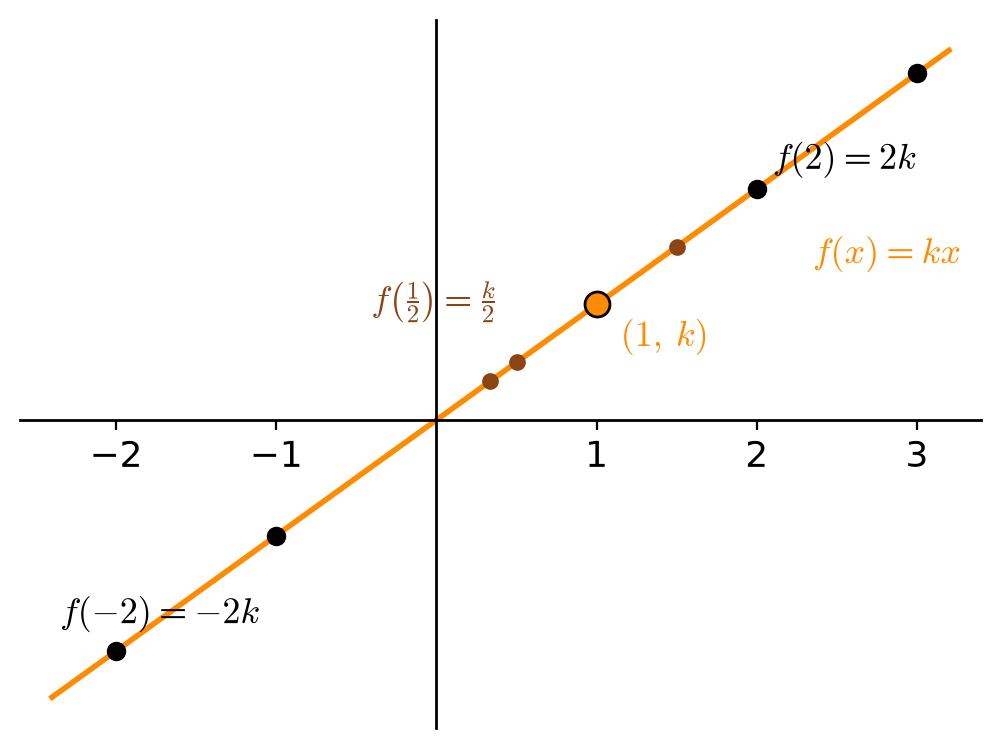
Additivity forces every value onto the line \(y=kx\): the single orange value \(f(1)=k\) determines the black integer values \(f(\pm n)=\pm nk\) and the brown fractional values such as \(f(\frac{1}{2})=\frac{k}{2}\).
Lemma (finite additivity). If \(f\) is additive, then for any \(x_1,\dots,x_n\in\mathbb{Q}\),
$$f(x_1+x_2+\cdots+x_n)=f(x_1)+f(x_2)+\cdots+f(x_n).$$Proof. Induction on \(n\): the case \(n=2\) is the definition, and for \(n+1\) terms group the first \(n\) and apply additivity, then the inductive hypothesis. \(\square\) In particular, taking all \(x_i\) equal to \(x\): \(f(nx)=n\,f(x)\) for every \(n\in\mathbb{N}\).
Direction 1: every map \(f(x)=kx\) is additive. Fix \(k\in\mathbb{Q}\). For all \(a,b\in\mathbb{Q}\), distributivity gives
$$f(a+b)=k(a+b)=ka+kb=f(a)+f(b),$$and \(kx\in\mathbb{Q}\) for \(x\in\mathbb{Q}\), so \(f\) does map \(\mathbb{Q}\) into \(\mathbb{Q}\).
Direction 2: every additive map has this form. Suppose \(f:\mathbb{Q}\to\mathbb{Q}\) is additive and set \(k:=f(1)\in\mathbb{Q}\). We show \(f(x)=kx\) for every \(x\in\mathbb{Q}\), in five steps.
Step 1: \(f(0)=0\). Additivity gives \(f(0)=f(0+0)=f(0)+f(0)\); adding \(-f(0)\) to both sides leaves \(f(0)=0\).
Step 2: \(f(n)=kn\) for all \(n\in\mathbb{N}\). Apply the lemma with \(n\) copies of \(x=1\):
$$f(n)=f(\underbrace{1+\cdots+1}_{n})=n\,f(1)=nk.$$Step 3: \(f(-x)=-f(x)\), hence \(f(n)=kn\) for all \(n\in\mathbb{Z}\). For any \(x\in\mathbb{Q}\), Step 1 and additivity give
$$0=f(0)=f\big(x+(-x)\big)=f(x)+f(-x),$$so \(f(-x)=-f(x)\). In particular \(f(-n)=-f(n)=k(-n)\) for \(n\in\mathbb{N}\), which with Steps 1 and 2 covers every integer.
Step 4: \(f(1/n)=k/n\) for every \(n\in\mathbb{N}\). We cannot reach \(1/n\) from \(1\) by adding, but \(n\) copies of \(1/n\) sum to \(1\), so the lemma gives
$$k=f(1)=f\Big(\underbrace{\tfrac{1}{n}+\cdots+\tfrac{1}{n}}_{n}\Big)=n\,f\Big(\frac{1}{n}\Big).$$Dividing by the nonzero integer \(n\) yields \(f(1/n)=k/n\).
Step 5: \(f(m/n)=k\,(m/n)\) for all \(m\in\mathbb{Z}\), \(n\in\mathbb{N}\). For \(m\ge 1\), \(m/n\) is the sum of \(m\) copies of \(1/n\), so by the lemma and Step 4,
$$f\Big(\frac{m}{n}\Big)=m\,f\Big(\frac{1}{n}\Big)=m\cdot\frac{k}{n}=k\cdot\frac{m}{n}.$$For \(m=0\) this is Step 1, and for \(m<0\) write \(m/n=-(|m|/n)\) and use Step 3 with the positive case. Every rational has the form \(m/n\) with \(m\in\mathbb{Z}\), \(n\in\mathbb{N}\), so
$$f(x)=kx\qquad\text{for all }x\in\mathbb{Q}.$$Conclusion. The additive homomorphisms \(\mathbb{Q}\to\mathbb{Q}\) are precisely the maps \(f(x)=kx\) with \(k=f(1)\in\mathbb{Q}\), one for each rational \(k\). \(\blacksquare\)