II.5 · Fields & Order — Problem 5 #
← Back to II. Fields & Order, Problem 5
Problem. Let \(S\subset\mathbb{R}\) have a lower bound, and set \(-S=\{-r\mid r\in S\}\). (a) Define the greatest lower bound (infimum) of \(S\) precisely and explain why it exists. (b) Show that \(\inf S=-\sup(-S)\).
Hint #
(a) The infimum is a lower bound that is greater than or equal to every other lower bound. For existence, note that \(-S\) is bounded above, and apply the least upper bound property to \(-S\).
(b) Negation reverses inequalities, so it turns lower bounds of \(S\) into upper bounds of \(-S\) and vice versa.
Solution #
(a) The number \(x\) is the infimum of the set \(S\) if
- \(x\) is a lower bound for \(S\), and
- if \(x'\) is another lower bound for \(S\), then \(x'\le x\).
(Existence.) If \(S\) is bounded below, then \(-S\) is bounded above, so by the least upper bound (completeness) property of \(\mathbb{R}\), \(\sup(-S)\) exists; part (b) then exhibits \(-\sup(-S)\) as the infimum of \(S\).
(b) Let \(x=\inf S\), so that
- \(x\le y\) for all \(y\in S\), and
- if \(x'\) is another lower bound for \(S\), then \(x'\le x\).
Then \(-x\ge -y\) for all \(y\in S\), i.e. \(-x\ge w\) for all \(w\in-S\) (writing \(w=-y\)); so \(-x\) is an upper bound for \(-S\). Now consider another upper bound \(z\) for \(-S\). Then \(z\ge w\) for all \(w\in-S\), so \(-z\le -w\) for all \(-w\in S\); hence \(-z\) is a lower bound for \(S\). Because \(x\) is the greatest lower bound, \(-z\le x\), which gives \(z\ge -x\). Thus \(-x\) is the least upper bound for \(-S\), i.e. \(-x=\sup(-S)\). Equivalently, \(\inf S=x=-\sup(-S)\).
Long solution #
Strategy. The completeness axiom of \(\mathbb{R}\) speaks only about least upper bounds. The reflection \(t\mapsto -t\) reverses all inequalities (Problem 3(a)), so it turns lower bounds of \(S\) into upper bounds of \(-S\) and “greatest” into “least.” We apply the least upper bound property to \(-S\) and check that \(-\sup(-S)\) satisfies the definition of \(\inf S\).
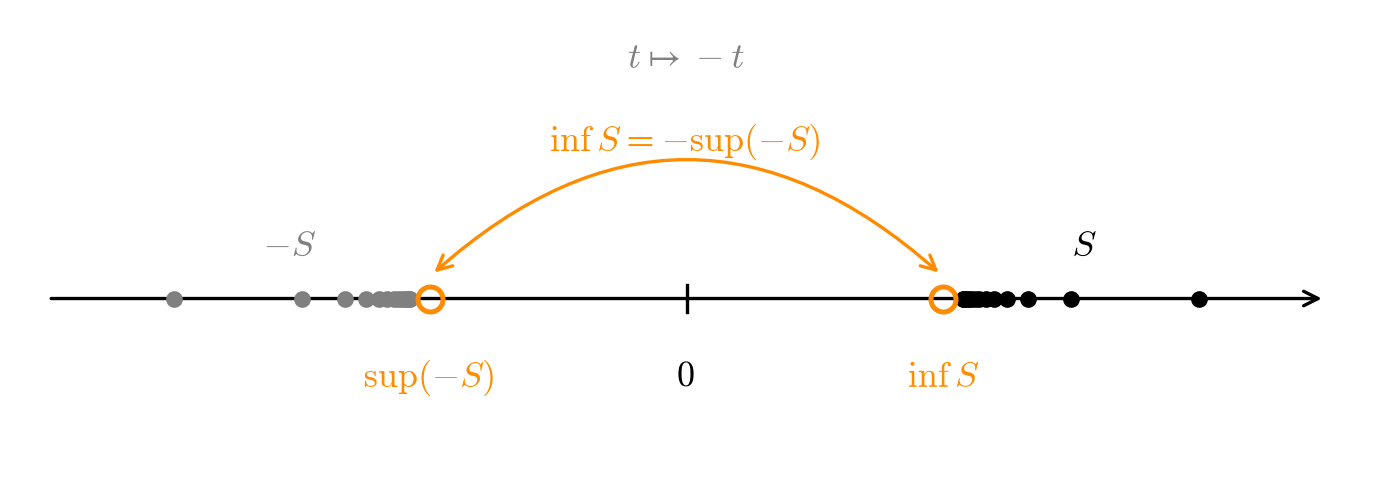
The reflection \(t\mapsto -t\) carries \(S\) (black) onto \(-S\) (gray), and carries \(\inf S\) to \(\sup(-S)\) (orange). Neither point needs to belong to its set.
Throughout we use the negation rule from Problem 3(a) in its non-strict form: \(u\le v\) if and only if \(-v\le -u\).
(a) Definition and existence.
The definition is the one stated in the Solution above; call its two clauses (i) and (ii). Such an \(x\) is unique: if \(x_1,x_2\) both satisfy (i) and (ii), then (ii) applied both ways gives \(x_1\le x_2\) and \(x_2\le x_1\).
Existence. Let \(S\neq\varnothing\) be bounded below, with lower bound \(\ell\), so \(\ell\le s\) for all \(s\in S\). Negating, \(-s\le-\ell\) for all \(s\in S\), which says that \(-\ell\) is an upper bound for the nonempty set \(-S\). By the least upper bound property, \(M:=\sup(-S)\) exists in \(\mathbb{R}\). Part (b) shows \(-M=\inf S\), so the infimum exists.
(b) \(\inf S=-\sup(-S)\).
Let \(M=\sup(-S)\). We verify that \(-M\) satisfies clauses (i) and (ii).
Step 1: \(-M\) is a lower bound for \(S\). Let \(s\in S\). Then \(-s\in -S\), so \(-s\le M\) because \(M\) is an upper bound for \(-S\). Negating gives \(-M\le s\). Since \(s\) was arbitrary, \(-M\) is a lower bound for \(S\).
Step 2: \(-M\) is the greatest lower bound. Let \(x'\) be any lower bound for \(S\), so \(x'\le s\) for all \(s\in S\). Negating, \(-s\le -x'\) for all \(s\in S\), so \(-x'\) is an upper bound for \(-S\). Since \(M\) is the least upper bound, \(M\le -x'\), and negating once more gives \(x'\le -M\).
Steps 1 and 2 are exactly clauses (i) and (ii), so
$$\inf S=-M=-\sup(-S).$$\(\blacksquare\)
Remark. The infimum need not belong to \(S\): in the figure, \(S=\{1+\frac{1}{n}:n\in\mathbb{N}\}\) has \(\inf S=1\notin S\).