II.3 · Fields & Order — Problem 3 #
← Back to II. Fields & Order, Problem 3
Problem. Let \((F,+,\cdot)\) be an ordered field and \(x,y\in F\). Show that (a) if \(x\lt y\) then \(-y<-x\); and (b) \(1>0\).
Hint #
(a) Add the same quantity to both sides of \(x\lt y\) — the order axiom lets you do this. Adding \(-x-y\) to both sides is the slick choice.
(b) First show \(x^2>0\) for every \(x\neq 0\), splitting into the cases \(x>0\) and \(x<0\). Then note \(1=1\cdot 1=1^2\).
Solution #
(a) By the first axiom of an ordered field (compatibility of \(+\) with \(<\)), \(x\lt y\) gives
$$-x+x<-x+y\qquad\text{and then}\qquad -y-x+x<-y-x+y.$$Using commutativity, the left side reduces to \(-y\) and the right side to \(-x\); that is, \(-y<-x\).
(b) First verify that for any nonzero \(x\), \(x^2>0\). If \(x>0\), this is true by the second axiom of ordered fields: \(x>0\) and \(x>0\) imply \(x\cdot x>0\). If \(x<0\), then \(-x+x<-x\), i.e. \(0<-x\); again by the second axiom, \(-x>0\) and \(-x>0\) imply \((-x)\cdot(-x)>0\). But \((-x)(-x)=x\cdot x\), so \(x^2>0\). Now since \(1\) is the multiplicative identity, \(1\cdot 1=1\), so by the result just shown (\(1\neq 0\)), \(1>0\).
Long solution #
Strategy. Only the order axioms may be used; no picture of the real line counts as justification, since \(F\) is an abstract ordered field. The only axiom that manipulates a strict inequality is O3 (“add the same element to both sides”), so part (a) comes down to choosing what to add: adding \(-x-y\) to both sides of \(x\lt y\) swaps the two sides. For part (b), \(1=1^2\) is a square, so it suffices to prove that every nonzero square is positive, splitting into the cases \(x>0\) and \(x<0\).
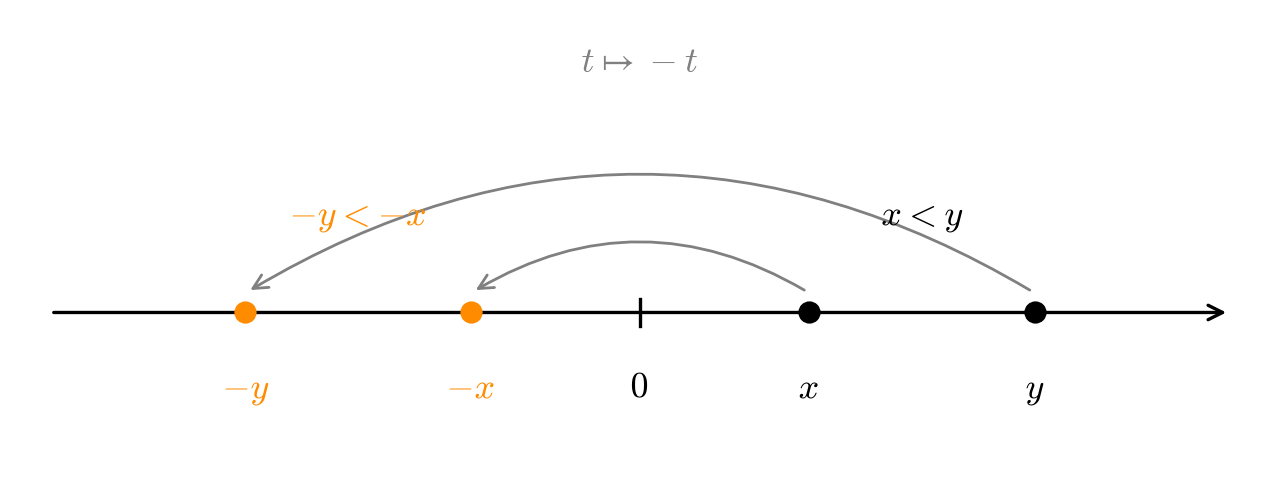
Negation reflects the line through \(0\): the pair \(x\lt y\) (black) lands on the pair \(-y<-x\) (orange), with the order reversed. Part (a) proves this picture from the axioms.
The ordered field axioms. An ordered field is a field with a relation \(<\) satisfying:
- (O1) Trichotomy: for all \(a,b\), exactly one of \(a\lt b\), \(a=b\), \(b\lt a\) holds.
- (O2) Transitivity: \(a\lt b\) and \(b\lt c\) imply \(a\lt c\).
- (O3) Compatibility with \(+\): if \(a\lt b\) then \(a+c\lt b+c\) for all \(c\).
- (O4) Compatibility with \(\cdot\): if \(a>0\) and \(b>0\) then \(ab>0\).
Here “\(a>0\)” is notation for \(0\lt a\).
(a) If \(x\lt y\) then \(-y<-x\). Apply O3 to \(x\lt y\) with \(c=-x-y\):
$$x+(-x-y)\lt y+(-x-y).$$Using associativity and commutativity of addition and the laws in A4, the left side is \(\big(x+(-x)\big)+(-y)=0+(-y)=-y\), and the right side is \(\big(y+(-y)\big)+(-x)=0+(-x)=-x\). Hence \(-y<-x\). \(\blacksquare\)
(b) \(1>0\). We prove a lemma that is useful well beyond this problem.
Lemma. In an ordered field, \(x^2>0\) for every \(x\neq 0\).
Proof. By trichotomy, \(x>0\) or \(x<0\).
Case \(x>0\). O4 with \(a=b=x\) gives \(x\cdot x>0\).
Case \(x<0\). Part (a) applied to \(x<0\) gives \(-0<-x\), and \(-0=0\) (because \(0+0=0\)), so \(-x>0\). O4 with \(a=b=-x\) gives \((-x)(-x)>0\). It remains to see that \((-x)(-x)=x\cdot x\), which follows from three field identities:
- \(0\cdot a=0\): distributivity gives \(0\cdot a=(0+0)a=0\cdot a+0\cdot a\); add \(-(0\cdot a)\) to both sides.
- \((-a)b=-(ab)\): \(ab+(-a)b=\big(a+(-a)\big)b=0\cdot b=0\), so \((-a)b\) is the additive inverse of \(ab\).
- \((-a)(-b)=ab\): by (2) twice, \((-a)(-b)=-\big(a(-b)\big)=-\big(-(ab)\big)=ab\).
With \(a=b=x\), (3) gives \((-x)(-x)=x^2\), so \(x^2>0\) in this case too. \(\square\)
Now \(1\neq 0\) by axiom M4, so the lemma applies with \(x=1\):
$$1=1\cdot 1=1^2>0.\qquad\blacksquare$$Remark. Two immediate corollaries. Applying part (a) to \(0<1\) gives \(-1<0\): in every ordered field \(-1\) is negative, the fact that dooms \(\mathbb{C}\) as an ordered field in Problem 4. And the lemma says squares are never negative, which is why \(x^2=-1\) has no solution in any ordered field. A common pitfall in part (a) is to “multiply both sides by \(-1\)”: no axiom permits multiplying an inequality by a negative number. That rule is a theorem, and part (a) is the first step of its proof.